
How to play cribbage
Cribbage is a two-player card game with a board, and the board is the point — you score by moving pegs, not by writing anything down. First player to 121 wins. This is the two-handed game, which is the one almost everybody plays.
What you need
- A standard 52-card deck.
- A cribbage board with two tracks of 60 holes plus a finish hole.
- Four pegs — two per player. You leapfrog them so your opponent can always see your last score.
Losing a peg is the single most common way a cribbage game gets ruined, which is roughly the reason this website exists.
1. The deal
Cut for first deal — low card deals, and dealing is an advantage because the crib is yours. The dealer gives six cards to each player, one at a time.
2. The crib
Both players throw two cards face down. Those four cards make the crib, and the crib is scored by the dealer at the end of the hand. So on your own deal you can throw cards that might help you twice. On your opponent's deal you throw whatever is least likely to help them — which is not always your two worst cards.
3. The starter
The non-dealer cuts the remaining deck and the dealer turns the top card face up. That is the starter. It counts towards both hands and the crib at the show. If the starter is a jack, the dealer immediately pegs 2 for his heels.
4. The play — counting to 31
Non-dealer leads. Players alternate laying a card face up in front of themselves, each calling out the running total. Face cards count 10, aces count 1. The total may not pass 31.
| What happens | Points |
|---|---|
| The running total hits exactly 15 | 2 |
| The running total hits exactly 31 | 2 |
| You match the rank just played (a pair) | 2 |
| A third of that rank | 6 |
| A fourth of that rank | 12 |
| You complete a run of three or more, in any order | 1 per card |
| Your opponent cannot play without passing 31 — they say "go" | 1 |
When neither player can play, the count resets to zero and play continues with whatever cards are left. The player who lays the last card of the whole play pegs 1 — or 2 if it landed exactly on 31.
5. The show — counting your hand
Now everyone picks their four cards back up and counts them with the starter as a fifth card. Non-dealer counts first, then the dealer, then the dealer counts the crib.
| Combination | Points |
|---|---|
| Any set of cards adding to 15 | 2 each |
| Pair | 2 |
| Three of a kind | 6 |
| Four of a kind | 12 |
| Run of three, four or five | 1 per card |
| Four-card flush in your hand | 4 |
| … and the starter matches that suit too | 5 |
| His nobs — a jack in hand matching the starter's suit | 1 |
The crib is scored the same way with one exception: a crib flush only counts if all five cards — four crib cards and the starter — share a suit.
The highest hand possible is 29. You will not get one.
6. Winning
Deal alternates and you repeat. The first player to peg 121 wins the moment they get there — mid-count, mid-play, it does not matter. This is why counting first matters so much: a non-dealer who pegs out on their hand means the dealer never counts their hand or their crib at all.
Win while your opponent is on 90 or less and it is a skunk. Win while they are on 60 or less and it is a double skunk, and they have to hear about it forever.
Three or four players
With three, each player gets five cards and one card goes straight to the crib. With four, play in partnerships of two, five cards each, one discard each. The scoring never changes.
Common house rules
- Muggins. If you undercount your hand, your opponent may claim the points you missed. Agree on this before you start, not after.
- Short game. 61 points instead of 121 — once around the board.
- Last card at 31. Some tables score 2 rather than 1+1. It works out the same.
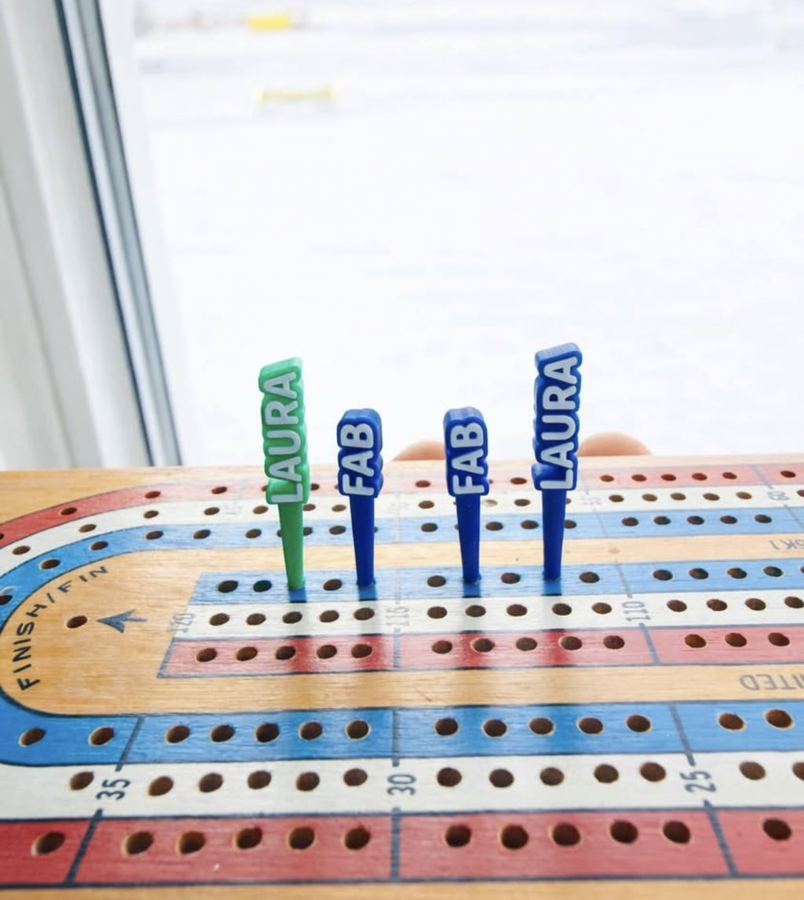
Never lose a peg again
Custom cribbage pegs with your name on them, so there is never an argument about whose peg is whose. From $2.50.
Design your pegz